Reading Time: 5-6 Minutes
Date: 19 June, 2026
Your toddler just hit the child sitting beside your table at the restaurant. You rush to pick up your child, apologize to the parents of another kid, and say all the right words, but you can still feel the silent glare of that woman looking at the whole scenario, and you know she is judging your parenting skills. You buckle your child in the car, drive off, and quietly wonder, what exactly are you doing wrong?
This isn’t bad behavior; it’s an incomplete language.
You’re not doing anything wrong, and your toddlers’ behavior doesn’t incline towards their upbringing; it’s an incomplete language. Hitting, biting, & pushing are some examples of behaviors every parent encounters among their toddlers, and they think, What are they doing wrong? But new parents need to understand this is the only communication tool that is available to their toddler right now. They are not aware of the words they can use to name their frustration, irritation, overwhelm, etc.
Toddlers of age around 1-3 have an expressive vocabulary of around 5-300 words, but their emotional experience is already complex, like an adult’s. The behavior usually seen is the mismatch between what they feel and what they say.
Research by Dr. Ross Thompson from UC Davis suggests that emotional regulation skills gradually develop from infancy through middle childhood, and toddlers are by far at the earliest step of this development.
Another 2019 study suggests that children showcasing behaviors like hitting, pushing, and biting do not show aggressive traits by the age of 5, as they have found their language. The whole scenario is developmental, not dispositional.
This is actually what’s happening.
You’ve just entered a movie theater, music plays at a high volume, and as usual, your toddler bursts out with emotions of irritation. That isn’t bad behavior; it’s all psychological. Toddlers have a lower sensory threshold than an adult. A noisy, crowded space can push their nervous system into an overload faster than their parents expect.
Research from the University of Washington shows that in situations with high stimulation, a biological response is triggered, i.e., their cortisol spikes within 20-30 minutes. Cortisol is often known as the stress hormone of the body.
Let’s look at another scenario: you are at a mall with your kids, you pass a beautiful vibrant toy store, and a toddler sets their eyes on a toy, and now they just can’t move forward without creating a scene. They need that toy right then. You must feel they are being stubborn, but actually what’s happening is that when a toddler does not have words to communicate, their body does the talking; this is usually common among children aged 18-30 months, before their vocabulary catches up to their social desires.
Not all hitting and pushing reflects anger; sometimes it’s their excitement that overshoots.
Research by Dr. Stuart Brown showcases that the excitement and anger inside a toddler’s mind light up the same neural pathways, resulting in the joy looking identical to aggression from the outside.
But why reasoning, time-outs, and threatening doesn’t usually work with your toddler at that moment?
Let’s understand this in simple words with a scientific model by Dr. Daniel Siegel, known as “Flipping The Lid.”
The prefrontal cortex, i.e., the thinking part of the brain responsible for control, impulse, reasoning, and empathy, goes temporarily offline during the time of emotional flooding, and what’s left in charge for all of it is the limbic system, the emotional center of the brain, which results in a pure emotional reaction with no communication or logic. You cannot reason with a child whose lid has flipped.
The thinking part of the brain, i.e., the prefrontal cortex, isn’t fully developed until the mid-20s. It’s barely online in the calm moments of the toddlers, which results in biological emotional outbursts, a daily event. This isn’t a character flaw; it’s biology.
Here’s what most parenting advice gets wrong.
The moment, irritation takes over, and it is totally understandable to get an impulse to raise your voice and it harshly feels impossible to hold back, but in the long run it doesn’t build anything. The main goal is to work on internal tools that the child can carry for life.
Research by Dr. Laura Markham shows that the punishment-based responses by adults can suppress their behavior at the moment, but they do not build the self-regulation skills that avoid recurrence.
As a result, children learn to hide their behavior instead of regulating their feelings.
A study from the Journal of Family Psychology shows that punishment-based approaches are usually linked to poorer long-term outcomes.
What to do at that moment?
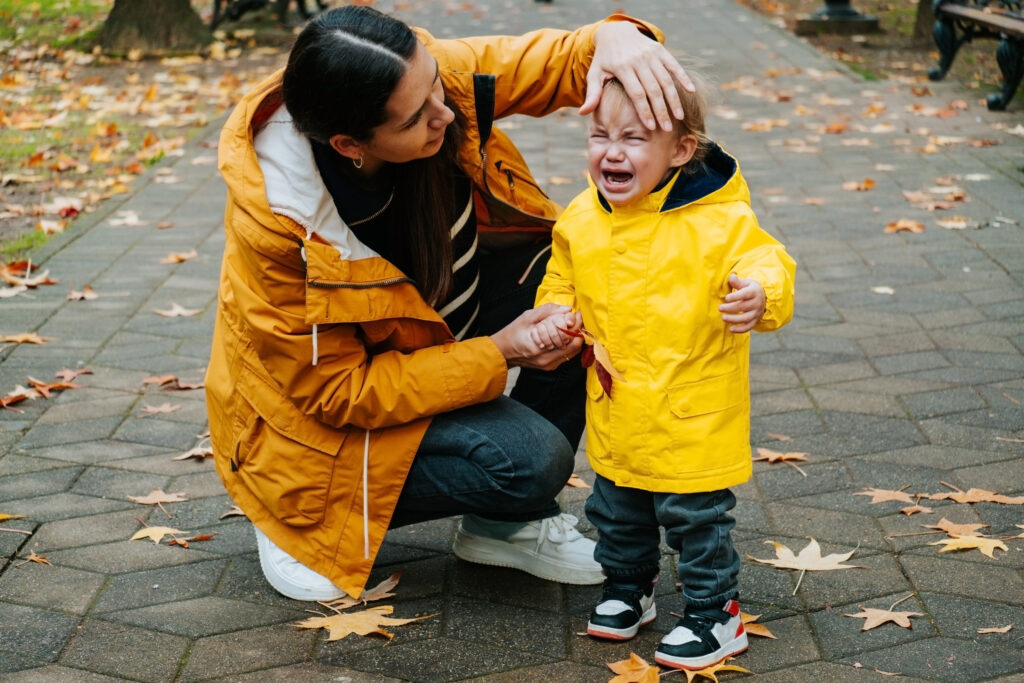
At that moment, get calm first. Acknowledge the feeling your little one is going through. Naming the emotion they might be feeling may feel like a small step but is actually effective. Naming helps in activating the thinking part of the brain, i.e., the prefrontal cortex. Simply putting feelings into words can reduce the emotional intensity of the brain. That’s the reason why “I can see why you’re frustrated” is not just kind; it is neurologically effective.
Start by acknowledging the feeling, then move towards stopping their current behavior without any shame and providing an alternative.
Reversing this flow, such as stopping the behavior without acknowledging their behavior, is comparatively less effective because the emotional brain is still in charge.
After the incident takes place, calm down your child, have a short & simple conversation with them about what happened, and talk about what they can do instead next time. This is when the prefrontal cortex, i.e., the thinking part of the brain, is back online, and now learning is actually possible.
What is this phase actually telling you?
Your child is not being stubborn on purpose; they are developing. Most children show a significant natural decline in physical aggression between the ages of 3 and 4 as their language development accelerates. Gradually the phase ends, and what a child actually learns about handling big emotions is what stays in the long run.
The child showcasing physical aggression is a child trying to be understood, our role at home and preschool is to build a bridge for them until they have the words to communicate.